Showing posts with label sports. Show all posts

Saturday, March 6, 2010

Bad Apologies!

I'd "rather die" than say sorry - Zinedine Zidane (Mar 2010)
...
"Never apologise and never explain... it's a sign of weakness." - 1949 film, She Wore A Yellow Ribbon
...
.
Footballers, whether they like it or not, are role models by virtue of their high profile. Over the past few weeks, two incidents involving famous footballers (both were captains of their respective national teams) have hogged the headlines.
The first incident involved France legend Zinedine Zidane, who headbutted Marco Materazzi during the 2006 World Cup final - an action which saw the France captain duly dismissed. That was to be the last game of his distinguished career. Italy went on to win the World Cup in a penalty shoot-out. In a recent interview (March 1, 2010), while Zidane admits he regrets what he did, he insists he will never apologise to Materazzi because of the insults against his mother that he claims provoked the headbutt.
.
The second incident involved Manchester City's footballer Wayne Bridge's refusal to shake hand with John Terry (Chelsea's captain), who had had an affair with Bridge's ex-girlfriend. Both were once best friends and teammates at Chelsea FC and England. As a result of the scandal, John Terry was removed as the team captain of England. Wayne Bridge, on his part, made himself unavailable for the World Cup citing John Terry’s failure to apologise as the main reason. When John Terry showed no signs of remorse in the statement he issued the day he was stripped of the England captaincy — and in his conduct towards Bridge himself — the Manchester City full back realised living in such close quarters to his one-time friend and colleague for the duration of a tournament was going to be impossible.
...
Hard to Say Sorry: Most people find it difficult to say sorry. As Gary Hayden wrote in his recent featured article in the Straits Times on Feb 25, 2010, "some people never accept blame and never apologise." In his article, Hayden highlighted some examples of bad apologies as well as how to say sorry.
.
Bad apologies are annonying and more likely to incense someone than it will placate him. Three examples of bad apologies highlighted by Hayden are:
.
(1) Insincere apologies - whenever a politician is caught with his hands in the till or a sportsman with his pants down, an apology will almost certainly ensue. However, we are left wondering whether the person concerned is sorry for what he did - or merely sorry he got caught. More often than not, we suspect the later.
.
(2) Half-baked apologies - these are often phrased using the passive voice. So instead of admitting "I made a mistake", we say "Mistakes were made". Instead of saying "I am sorry I wrecked your car," we say "I am sorry your car was wrecked". At the heart of these ineffectual apologies is an unwillingness to be fully responsible for what has happened.
.
(3) Back-handed apologies - worse, these are really non-apologies. Instead of saying "I am sorry I offended you, ", we say "I am sorry you took offense". The implication here is that you ought not really to have taken offence and Ihave not really done anything wrong but I had better apologise anyway or else I may never hear the last of it. Other examples of backhanded apologies, which subtly shift responsibility onto the victim, include "I am sorry if anyone misunderstood me" and "I am sorry you feel that way".
.
An incomplete apology is often, quite rightly, seen as a second insult. In the next blog, I will continue with the tips offered by Hayden on "how to say sorry".

source: Gary Hayden, "Hard to Say Sorry", The Strait Times (Feb 25, 2010); http://www.dailymail.co.uk/sport/football/article-1253880/John-Terry-didnt-say-sorry-The-reason-Wayne-Bridge-quit-England.html#ixzz0hM05le1v

Tuesday, January 27, 2009

Wrong Way Riegels

During my sabbatical in the US, I learnt to appreciate the game and rules of American football. The fact that university teams could have stadiums bigger than some of the biggest soccer teams in England still amazes me. At the end of the season, the more successful college teams earn the right to play in bowl games. And one of the most colorful bowl games is the Rose Bowl Game, which is played on 1 January of each year, between the Big Ten and the Pacific-10 conference representatives.

The Rose Bowl Game is accompanied by the Rose Parade, which featured magnificent floral floats. We attended the parade at Pasadena, LA in 2005.
The Rose Bowl Game also contributed one of the most memorable moments in the college football history. Roy Riegels played for a team in the Rose Bowl years ago (1929) that had the ball in its possession right at the goal line about to score. Riegels got hit and got turned around. He didn't realize what had happened, but he started running in the wrong direction. He ran 99 yards in the wrong direction. He was tackled on his own one-yard line by his own teammates to keep him from scoring two points for the other team.

Riegels said that when he was tackled by his own teamates, he got up angry and began to chew his teamate out: "Why in the world did you tackle me?" Then he realized what had happened. He realized he almost scored for the other team. He may have cost his team a score because they were about to score at the other end of the field. He said that he was so embarassed, so humiliated, so disgraced... After a while halftime came. The players came in and gathered in small groups all over the dressing room just whispering. He said he just knew everyone was talking about him. He said that he was so discouraged and so much in despair that at that moment, he thought he would never leave the dressing room alive. He didn't want to live another day.
Then the coach came in and gathered the players around him. Roy said the coach looked right at him and pointed his finger at him and said, "Roy, when you go in this half ..." Roy was crying. "Coach, I can't go in. I may have cost us the ball game. I have embarassed the team. I have done a stupid thing. I can't go in."... He said the coach... came over to him. He put his arm around his shoulder and said, "Roy, remember the game is only half over".

Good thing is, Riegels came back to be team captain the next year, led a successful life after college and is now in the Rose Bowl Hall of Fame. The play is also credited with bringing increased popularity to college football. Roy said that the hand over his shoulder at that most desperate moment in his life literally save his life. Roy went one to become an outstanding high school football coast in the western US, but it was because in the darkest moment of failure, there was one who cared enough to put his arm around him and say, "Roy, remember the game is only half over."

Son of Encouragement:
"You may have stumbled. You may have fallen. The game is not over yet. God's grace is big enough to lift you up".

source: J.T. Draper

Tuesday, October 14, 2008

F1: Miracle on Singapore St

"I will need a miracle ... to be able to make progress on this street circuit where it looks difficult to overtake." - Fernando Alonso
The 2008 Singaporean F1 Grand Prix was the first in the F1 history to be staged at night. My wife and I, were given two tickets for the three-day event, but we decided to give them away to relatives who are more enthusiatic about the race. Held in September 08, the race was a new experience for every driver because it involved driving on a street circuit under powerful spotlights. The race also turned out to be one of the most exciting of the season.
..
Fernando Alonso, in his Renault, had set the fastest time in the practice runs. But the Spaniard's hopes of pole position were dashed... A car failure during the qualifying runs on Saturday left him a wretched 15th - a starting position no driver had ever won a Grand Prix from in the 799 world championship events leading up to this race. Struggling to conceal his frustration at, Alonso said he will need a miracle to claw his way into the points.

“Our weekend was going really well and we had big hopes for this evening… It’s a really big disappointment because we had a real chance to do something special today, perhaps not pole position but to at least qualify in the top four… I know that starting in the middle of the pack will make for a difficult race and … … I will need a miracle … to be able to make progress on this street circuit where it looks difficult to overtake."

The next day, Alonso, against all odds, won the incident-packed race. A commentator reported that it took a strategic gamble and a stroke of fortune to bring him into play on race day. After the race, Alonso reflecting on the win, said...
Alonso got the miracle he wanted!
.
.
.
.
.
"We were unlucky in qualifying and very lucky in the race. Obviously we started at the back … After qualifying our hopes were gone already (as we started 15 and 16). It was nearly over, but it shows that Formula One is unpredictable on Sunday... I need a couple of days to realize we won a race this year."

Whilst Alonso's win might have looked lucky, note that his good fortune in the race was at least partly caused by his misfortune during qualifying. One reported aptly wrote "Any winner after two hours of a bumpy, barrier-lined track in such heat must be a worthy one."

What is the moral of this story? One, never give up no matter how dissappointed or 'unfortunate' you feel. Two, the race ain't over till you've crossed the finishing line! Three, "luck is preparation meeting opportunity", i.e. we have to be prepared to take advantage of opportunities that come our way. Four, when hope is gone, start praying for a miracle?
.
postscript: Two weeks later, Alonso went on to win the next Grand Prix race in Tokyo, also coming from behind. So, who says, miracles can only happen once?

Saturday, June 7, 2008

Something for JOEY

Growing up, I remember watching “Something for Joey”. Based on a true story, the movie is about the relationship between John Cappelletti, a college football player, and his younger brother Joey, who battled with leukemia since the age of five. Focusing on the close bond between the two brothers, the story traces John through his years at college and Joey through his preteens - as each brother inspires the other, and their family around them, to try harder in life. The final scene of the movie was so touching that many shed tears:-
John wins the Heisman trophy and is recognized as the nation’s most outstanding college football player of the year. During his acceptance speech, John names Joey as his prime motivator, then gradually breaks down in tears, as he tells everyone he wants Joey to have his trophy, for inspiring him and for enduring so much difficulty with leukemia. The whole Cappelletti family is there, and Joey runs to John's side (source: wikipedia).
....
The film ends by revealing Joey succumbed to his leukemia and died with John by his side on April 8, 1976.

It was only after reading a book on Joe Paterno and the history of Penn State football that I realized the setting for the real story was in Penn State. John Cappelletti played for the Nittany Lions. He attended Penn State University, where he won the Heisman Trophy in 1973. Cappelletti went on to play professional football from 1974 through 1983 for the Los Angeles Rams and the San Diego Chargers. He was inducted into the College Football Hall of Fame in 1993. John Cappeletti remains the only player in Penn State’s football history to have won the Heisman Trophy. Penn State legendary football coach, Joe Paterno, said that Cappeletti was “the best football player I ever coached.”

Cappelletti's Heisman acceptance speech, where he dedicated his award to his dying brother Joey, is one of the most memorable in the history of college sports. He touched the cold hearts of many Wall Street merchants and had cynical journalists and professional athletes wiping their misty eyes when he dedicated his 1973 Heisman Trophy to his 11-yr old brother Joey who was suffering from leukemia. Speaking at a gathering that included the Vice President of the United States and other luminaries, the big Penn State tailback uttered one of the most intelligent and thoughtful short talks in American sports history. He brought the house down in tears and had wet eyes himself when he concluded by saying,
..
“The youngest member of my family, Joseph, is very ill. He has leukemia. If I can dedicate this trophy to him tonight and give him a couple of days of happiness, this is worth everything.”… “I think a lot of people think that I go through a lot on Saturdays and during the week as most athletes do. You get bumps and bruises and it is a terrific battle out there on the field. Only for me it is on Saturdays and it’s only in the fall. For Joseph, it is all year ‘round and it is a battle that is unending with him. He puts up with much more than I’ll ever put up with and I think that this trophy is more his than mine because he has been a great inspiration to me."

The speech was so touching that the relationship between Cappelletti and his younger brother Joey, was made into a movie in 1977 called Something for Joey.
.
reflection: there is no education like adversity
.

Source: 40 years of the Joe Paterno Era at Penn State – from the sports pages of the Centre Daily Times

Friday, June 6, 2008

Joe Paterno - No Ordinary Joe!

“They asked me what I’d like written about me when I’m gone. I hope they write I made Penn State a better place not just that I was a good football coach.” – Joe Paterno
.
Everyone who follows the game of soccer would know who Alex Ferguson is. As the longest serving and most decorated manager in the English Premier League, Alex Ferguson is regarded as one of the game's greatest managers. Similarly, in the world of college football, the name Joe Paterno is equally revered! In Dec 2007, Joe Paterno was inducted into the College Football Hall of Fame, which is the highest honor in college football.
/
Joe Paterno, is the legendary coach of Penn State football team. Next year, will be his 43rd year as the head coach, which is remarkable for a sport in which the players change with each season. Joe Paterno, who is 81, said he tackled each new season with the same energy and enthusiasm as the one before. However, his days as football coach of Penn State are numbered! The university recently announced that his contract will not be renewed when the current deal expires next year.


In 1982, Paterno & Penn State finally broke through, defeating Georgia in the Sugar Bowl to win their first national championship. Another followed 4 yrs later.

Joe Paterno came to Penn State, as a 23 year-old kid, in 1950. That’s 58 year ago!After serving as a member of the coaching team for 16 seasons, he was promoted to head coach in 1966. Since then, he has led Penn State to two national championships and five undefeated seasons. Indeed, JoePa, as he is affectionately called, is an iconic figure on and away from the football field - a symbol of tradition and pride for generations of Penn State alumni and fans and a chief ambassador of college football.

How much does Joe Paterno earns? US$ 512,664 annually! That is only the base salary, which does not include additional fees from television and apparel contracts as well as other game bonuses. But if Paterno has earned the status of a celebrity, he does not show off. It was noted that he lives in the same modest home in State College where he raised his five children and where he entertains recruits with his wife’s lasagna dinners and quiet conversation. His wardrobe is simple and unchanged, .., and ties that outdate many of his players.
Paterno’s contribution to the university transcends the football field. Over the years, he has also donated more than US$4.2 million to Penn State. Joe Paterno, along with his wife, also engineered a $14 million campaign to expand the university library, which is now called the Paterno Library.

“The purpose of college football is to serve education, not the other way round.”

"What are coaches? Number one, we're teachers and we're educators. We have the same obligations as all teachers at our institutions, except we probably have more influence over our young people than anyone other than their families."

Although we have not met Joe Paterno in person, we share something in common. Well, we learned from our landlord that JoePa, in his early days in State College five decades ago, used to live in the same house we are currently staying in. In fact, he occupied the smallest room in the house, which is currently our study room. If you can imagine living in a house Alex Ferguson used to stay as a young man, then you can imagine our feeling staying in a house with such a history!

==================I see that you posted something about Penn State football on your blog. I can't remember whether we told you this or not, but Joe Paterno used to live in our house. His bedroom was the study on the main floor. The house was built by a family named the O'Horas in 1957-8. Jim O'Hora was the defensive coordinator at Penn State, and for a while after he moved to town, JoePa lived with the O'Horas.

Once a few years ago, Jim's children drove Jim past the old house to have a look. I wasn't home but Cricket and the girls were, so they had a chance to talk to him. Another time, Cricket called his wife Elizabeth before she died and learned a little bit about the house. For instance, Elizabeth had wanted a larger entry to the kitchen from the garage (where the pantry is now), but they had to make it smaller in order to provide a large closet in JoePa's bedroom to hold his suits. :) So when you wrote on your blog that some people have a Nittany Lion room in their house, it turns out that you do too! - Dave.
Reference: No Ordinary Joe, The Daily Collegian "Paterno's base salary: $512,664" (Nov 30, 2007), "Commerative Edition - History in the Making" (Dec 2007), The New York Times "Question of Age is Getting Old" (Apr 20, 2008).

Friday, March 14, 2008

Snow Sledding

We ate at the Chinese takeaway today. Usually, after the meal, you are given a fortune cookie. Mine read, "you will never regret the present, you live life to its fullest!". It also came with a set of "lucky numbers", 3, 22, 24, 27, 28,29.
..
So, when is the last time you "jumped in" to anything? Honestly, can you remember the last time you broke with routine and did something unusual?

Slab Cabin Park at 316 Elmwood Street. During the winter, especially after a few inches of snow fall, you will find families converging to this hill for sledding.

So far, we have visited this community park twice. The first time, we went on our own. The second time, we went with our neighbors and bumped into another neighbor and a church friend there.

If you have not tried it, sledding down a hill is crazy fun. It is a little harmless, although we have seen a kid ended up in the stream b'cos the sled was travelling at a very high speed.

The habit of always putting off an experience until you can afford it, or until the time is right, or until you know how to do it is one of the greatest burglars of joy. Be deliberate, but once you've made up your mind, jump in! - Tim Hansel

click to play video

What are you doing to keep the cutting edge of your life razor sharp? Perhaps another way to ask that is for what are you waiting? Or for whom are you waiting? How many burglars of joy do you allow to break through the doors and windows of your life to rob you of fun, the challenge of living life to the fullest?


To live on the dull edge is really to become a slave to life. Is that happening to us? Are we allowing someone or something to enslave us, so that we will live our lives and ultimately pass from time to eternity without ever discovering who we are? Some do. That's not living. That's existing.

Source: Charles Swindoll, living on th ragged edge, pp.338-9.

Saturday, December 1, 2007

Nittany Lions Football

Football is very popular throughout North America. In the US, the term “football” is reserved for American football, whilst the more familiar football game that is played in other parts of the world is known as “soccer”. Football, which a collision sport, is played by men, whilst soccer is more of a women’s game here.

A game consists of four 15-min quarters, with an intermission at 1/2 time. Because the clock stops after certain plays, a game can often last 3 hours, and the game is on TV, commercial timeouts are taken at certain intervals.
College Football: Nearly every college and university has a football team, no matter its size, and plays in its own stadium. The largest, most popular collegiate teams routinely fill stadiums larger than 60,000. It is, therefore, not surprising that football is generally the major source of revenue to the athletic programs of schools, public and private, in the US.

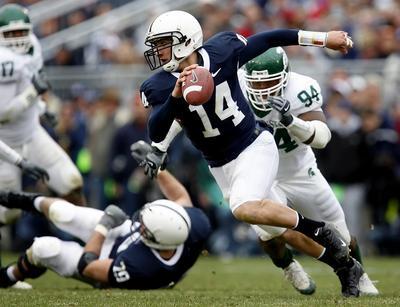
To say football is BIG here is an understatement! In PennState, football is a RELIGION! Under the tenure of its legendary coach, Joe Paterno, the team has won two national football championships. The team plays it home game at the Beaver Stadium. With a capacity of 107,282, it is the 2nd largest stadium in the US (smaller than Michigan Stadium by 219 seats), the 3rd largest stadium in North America, and 6th largest stadium in the world! The most incredible thing is that despite the small population in State College, match days are usually a sell out. For one of the games this season, tickets were selling on the e-bay at > US$1,000! Also, I am told that on each match day, the university earns around US$ 2 million!

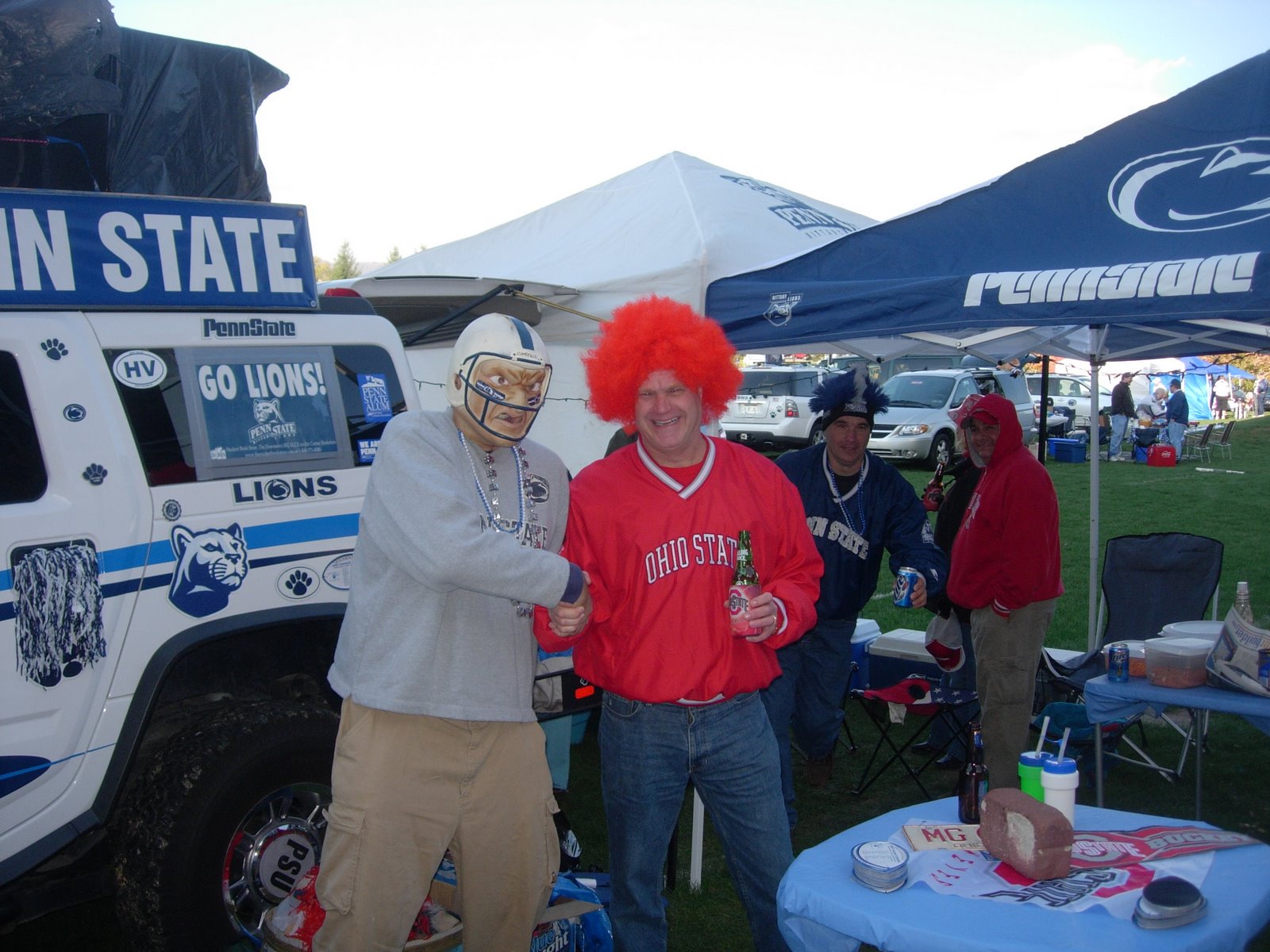
The weekly autumn ritual of college football includes marching bands, cheerleaders, homecoming, parties, the tailgate party; it forms an important part of the culture in much of small town. A number of local residents will put up a Nittany Lion flag outside their house on matchday! In addition, a neighbor informed me that most local families are die-hard supporters and have a Nittany Lion room in their house. There is also a Nittany Lion shrine in the campus.

Play the video below for a feel of the vibe and energy involved prior to a game outside the stadium.

Penn State's most well-known athletic cheer is "We are...Penn State." Typically, the students and cheerleaders shout "We are," followed by a response of "Penn State" from the rest of the fans.

Reference: Wikipedia